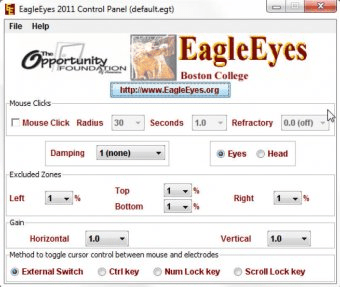
EagleEyes 2011 is a revolutionary technology developed at Boston College to facilitate communication and learning for individuals with severe congenital special needs, who are often non-verbal and paralyzed. This technology enables users to control the mouse pointer with their eyes, allowing them to select items on the screen by looking at a small area for a short period of time. EagleEyes 2011 is compatible with any commercial software and can be used to improve computer skills, language skills, reference skills, scientific knowledge, and teaching techniques.
EagleEyes is an innovative technology developed at Boston College that enables communication and learning primarily with individuals who have congenital severe special needs. These individuals are most often non-verbal, paralyzed, and at most have a "Yes/No" method of communicating with those around them. Basically, the mouse pointer follows the location that the user is looking at on the screen. The eyes replace the mouse. Selection is made by looking at a small area of the screen for a short period of time, which causes a mouse click. Usable with any commercial software, EagleEyes is a general mouse replacement that is based on measuring a user's EOG or electro-oculographic potential. The EOG is a small electrical potential which indicates the position of the eye relative to the head. Surface electrodes are placed on the user's head, above and below one eye, and on each side of the head to the left and right of the eyes. The five electrodes are connected to a small battery-powered electrophysiological amplifier which is connected to a computer. A program in the computer translates the signals received from the electrodes into the position of the mouse pointer on the screen. When the user moves his or her eyes, the mouse pointer moves. There are thousands of children and adults in the US and UK who could benefit from EagleEyes. Expanding the distribution of this great technology to meet the need is dependent upon generous personal donations and grants from private foundations.





Comments